Using Watercolor Templates – Why They Aren't Cheating, but Make Getting Started Easier
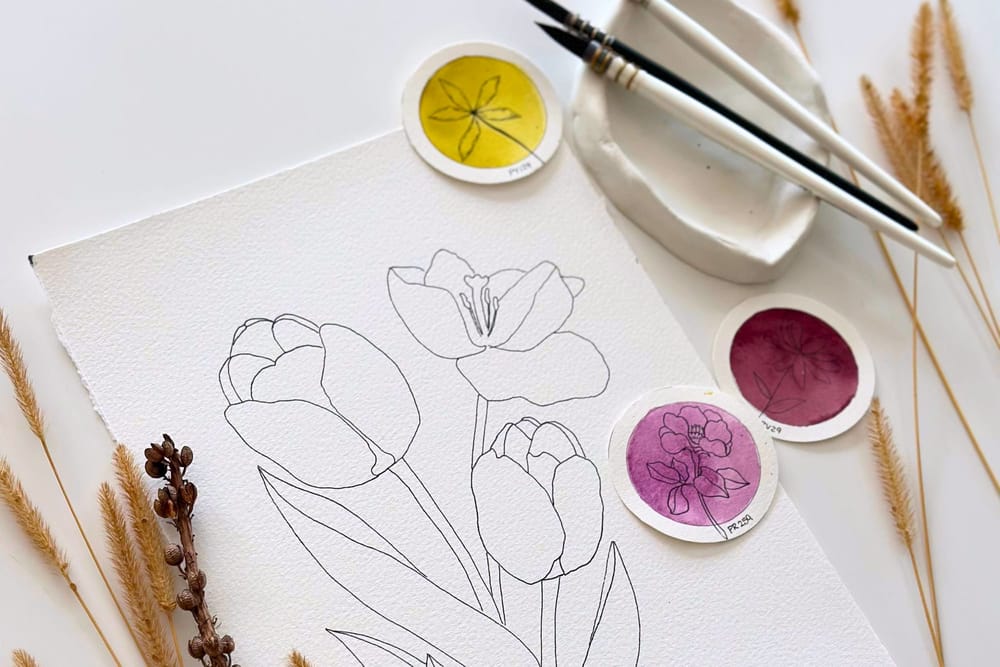
Hardly any topic in watercolor is debated as heatedly as templates. Are you even allowed to use them? Do you really learn to paint that way? Or is it, in the end, just copying?
I see this differently today than many traditional art schools do. A template doesn't take the painting off your hands. It only takes away the fear of the blank page.
Beginners in particular often face the same challenge: they want to paint a flower, but already fail at the drawing. Before any paint even reaches the paper, frustration sets in. Yet drawing and watercolor painting are two different skills. Anyone who wants to learn watercolor should first be allowed to focus on water, pigments, gradients and light – without having to fight over proportions or leaf arrangements at the same time.
A template doesn't replace the painting
It's often claimed that templates limit creativity. I actually believe the opposite is true. An outline only sets the shape of the plant. Everything else emerges during the painting process.
Which colors you choose, how loosely or precisely you paint, whether you build up several glazes, add splatters or design the background completely freely – that's decided by your handwriting alone. Even if ten people use the same template, ten different pictures emerge in the end.
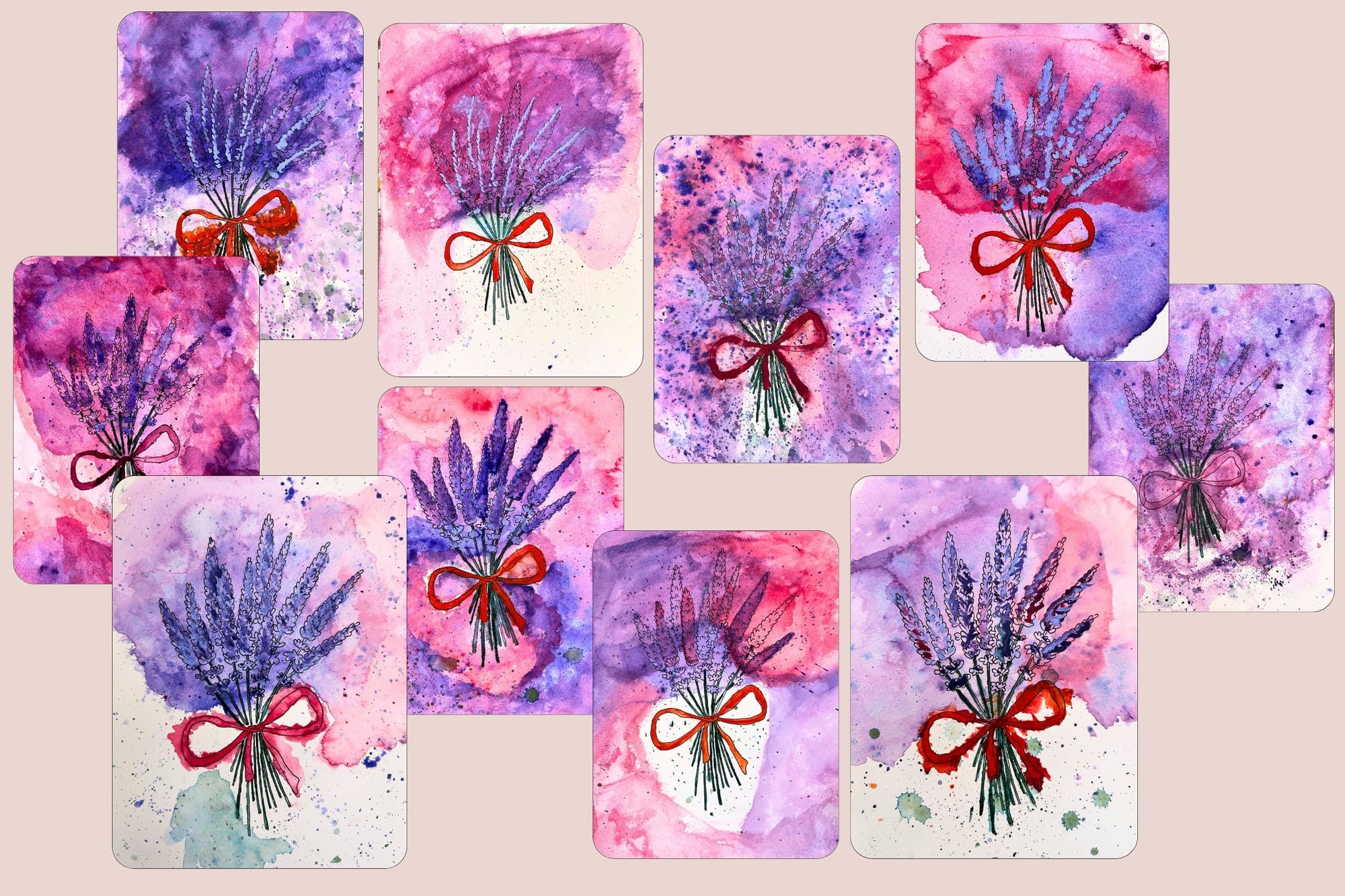
I got to experience exactly that recently at a children's birthday party. Ten children painted the same lavender template step by step, following my instructions. Although they all had the same drawing in front of them and used the same colors, every picture looked different in the end. Some worked very carefully, others more loosely. Some stuck closely to my explanations, others developed their own style. That's exactly what makes watercolor so exciting.
Even experienced artists use templates
Templates, by the way, are by no means only an aid for beginners. In a poll on Instagram I asked eight artists whether they prefer to paint with or without an outline, and which finished picture they liked better. Seven out of eight preferred the version with an outline.
That hardly surprised me. Anyone who paints regularly knows how much time and concentration already go into a good drawing. A clean template creates space for what watercolor is really about: water, colors, light and atmosphere.
My templates in the atelier
All registered users of my atelier can download the botanical templates for free as a PDF in A4 format. Depending on your printer, there are various ways to transfer them onto watercolor paper.
If you have a laser printer, you can print the template directly onto watercolor paper. The toner is waterproof and therefore ideal for watercolor.
It also works easily with a pigment ink printer. I use a pigment printer myself. After two days of drying at the latest, the prints are waterproof and can be painted on as normal.
With most conventional inkjet printers, things look a little different. The water-soluble ink would dissolve again and smear while painting. In that case, I transfer the template a different way.
Transferring a template at the window
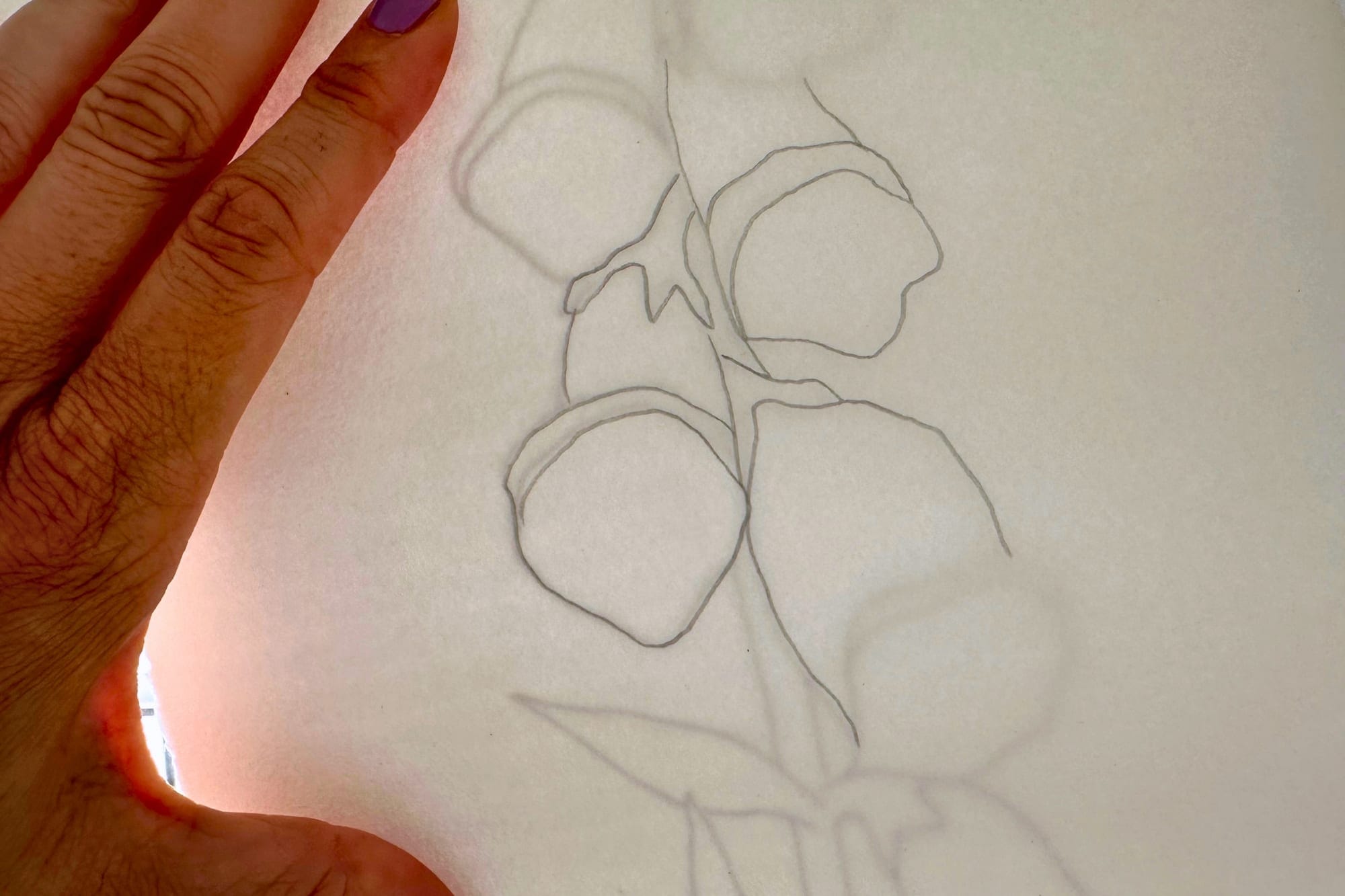
The simplest method needs no extra materials at all. First print the template onto normal printer paper and hold it, together with the watercolor paper, against a bright window. The light shines through both sheets, so you can comfortably transfer the lines onto the watercolor paper with a pencil.
This method works especially well with fine watercolor paper and good lighting.
Transferring a template with pencil
If the paper is too thick or there isn't enough light, I use a classic transfer method.
To do this, hatch over the lines on the back of the printout completely with a soft pencil. Then place the printout on the watercolor paper and trace the lines on the front with a firm pencil or a ballpoint pen. The pressure transfers the graphite from the back onto the watercolor paper and leaves a fine copy of the drawing there.
If you'd like a waterproof black outline later, you can trace these transferred lines neatly with a waterproof fineliner.
Why I work with templates today
My way of working today actually grew out of a piece of criticism.
More than twenty years ago, I showed one of my watercolors to an art professor. I had added some details with a fineliner, because I felt it gave the plant structure and character. I'll probably never forget his reaction. He said I had 'ruined' my picture with it.
That sentence stayed with me for many years. I felt there were fixed rules in painting that you had to follow. No outlines. No fineliners. No visible contours. For a long time I believed good art had to stick exactly to these ideas.
After a longer creative break, I started painting botanical watercolors again. At first I painted quite classically, with color only. The pictures were pretty, but they didn't feel complete to me. So I reached for the fineliner again and added leaf veins, stems and fine textures. Suddenly the plants had exactly the expression I had been looking for.
With the next picture I went a step further. I first developed the complete outline and then painted over it – just as I still do today. And I didn't even try to stay neatly within the lines. On the contrary: I deliberately let colors run over the contours, added splatters and gave the pigments room to find their own way.
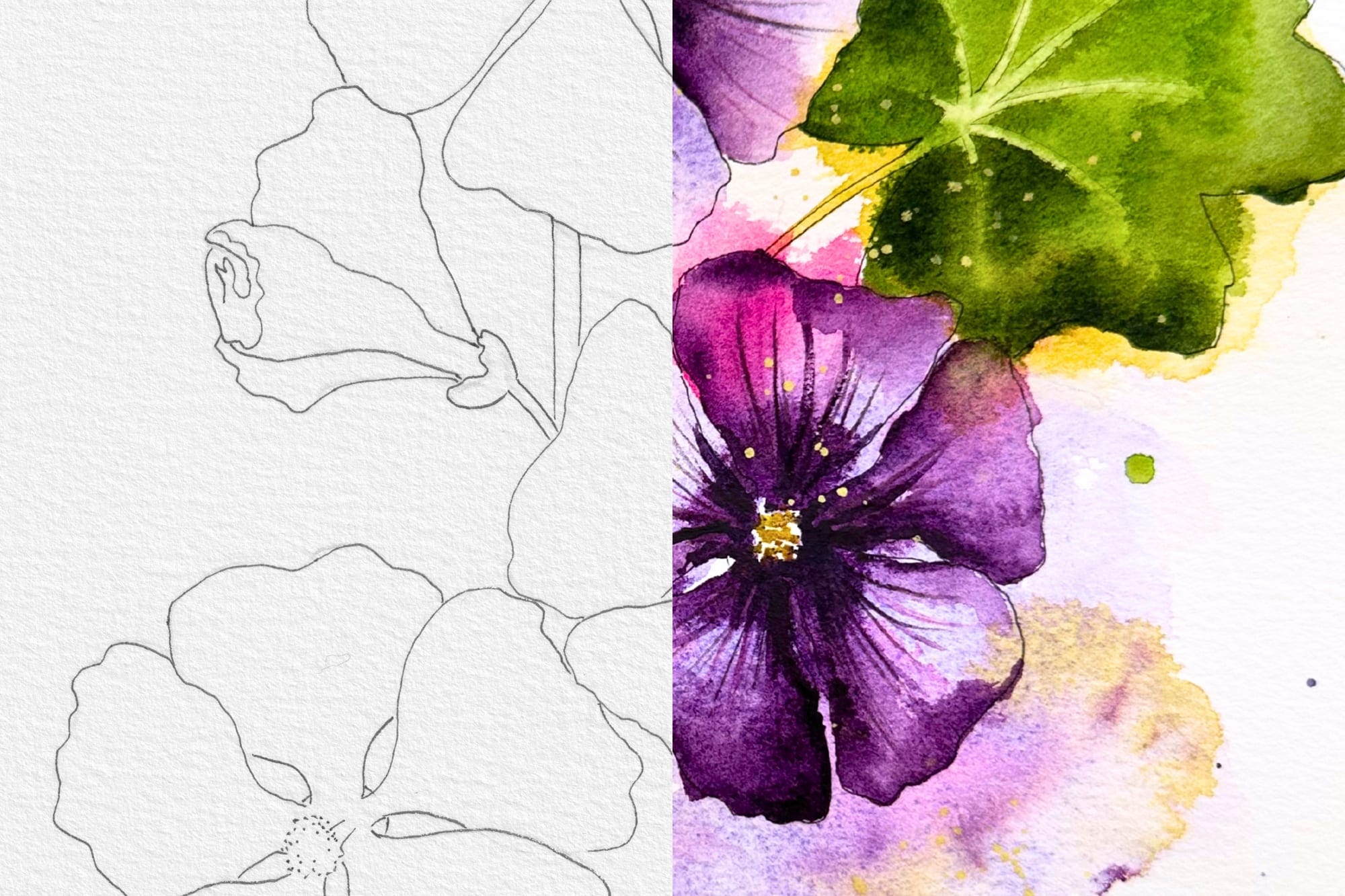
At some point I realized that the outline was never a limit for me. It was always a starting point.
Maybe that's exactly why this way of working appeals to me so much. As a neurodivergent person, I've often experienced that everyday life is full of unspoken rules and social expectations that seem self-evident to others. At some point I learned that not every boundary makes sense, and that sometimes it's your own path that works best.
I find exactly this feeling again in painting. The lines may be there. They give support and security. But they don't dictate where water and pigments are allowed to move. The most beautiful gradients often appear precisely where the color leaves the outline and finds its own way.
That's why my templates aren't stencils that limit creativity. They create a safe start and at the same time give the freedom to fully engage with colors, water and the character of a plant.
My conclusion
For me, templates aren't a sign of missing creativity, but a tool that makes getting started easier. They take away one of the biggest hurdles in painting – the blank page – and create space for what watercolor is really about: working with water, pigments, light and atmosphere.
Beginners in particular benefit, because they don't have to spread their attention across drawing, proportions, colors and technique all at once. Instead, they can experience step by step how a personal watercolor emerges from a simple outline.
That's exactly why botanical templates have been part of my atelier from the very beginning. They aren't meant to take work off anyone's hands. They're meant to make it possible to start at all. Because often it's precisely this first step that is the hardest – and at the same time the most important.